Introducing Mary Wollstonecraft, by N.J. Mastro!

(Welcome to Woldwinite Wednesday! I’m proud to introduce this week’s guest essayist, N. J. Mastro, author of Solitary Walker: A Novel of Mary Wollstonecraft, here to introduce us to the second half of all Woldwinite equations, Mary Wollstonecraft herself. Thanks again, N.J! — Litcuzzwords.)
An Introduction to Mary Wollstonecraft, By N.J. Mastro
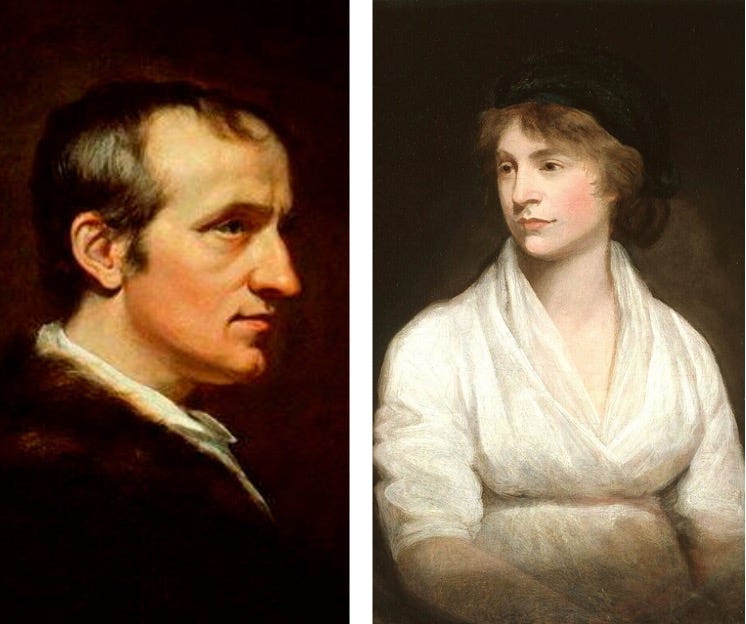
It is unimaginable to think about William Godwin without musing over Mary Wollstonecraft’s influence on this stoic nonconformist. Individually, Godwin is considered the founder of philosophical anarchism. Historians call Mary Wollstonecraft the mother of feminism. Together they are often referred to as the parents of the Romantic Movement, in part for giving birth to their daughter, Mary Godwin, who one day would wed one of Godwin’s intellectual mentees, Percy Bysshe Shelley. (Below: Godwin, 1802; Mary, 1797.)
That either William Godwin or Mary Wollstonecraft married at all is stunning. As philosophers, each had been critical of the institution in their respective writings. Mary had compared it to prostitution for women; Godwin had called it the worst of monopolies. And when the couple first met in 1791, they found each other tedious.
In 1791, Godwin was working as a journalist. Mary was living independently, supporting herself as a writer. Hers was an unorthodox, even improbable existence for a woman in the 18th century. Paid far less for their writing than men, women rarely earned enough on which to live. Most relied on family money or a husband to augment their paltry earnings.
Mary, however, was a sworn spinster with two advice books and one novel to her name, and she wrote for the Analytical Review, a progressive periodical. It wasn’t until 1790, however, when she penned A Vindication of the Rights of Men, a scorching response to Edmund Burke’s Thoughts on the Revolution in France, that she waded into polemical works.
In his political pamphlet, Burke, a powerful conservative Member of Parliament, wrote a scathing rebuke of the French Revolution, which was in its third year. The British Crown and Parliament were increasingly nervous that a rebellion across the Channel might incite unrest at home. Burke sought to tamp down the possibility by criticizing the basis for and the manner and speed in which the French rebels were seeking to dismantle their country’s power structure.
Mary, however, was an ardent supporter of the Revolution and took issue with Burke. An antimonarchist, she wrote her response in just 28 days, making hers the first to reach the British public.
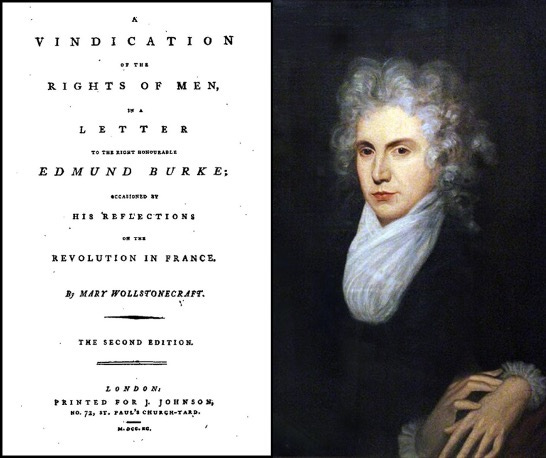
No one knew, however, that Mary had written the pamphlet. The establishment did not welcome women’s views on politics, so Mary identified herself as an anonymous author. But when the popular pamphlet sold out in three weeks, Mary and her publisher, Joseph Johnson, identified Mary as the author in a second edition. In doing so, A Vindication of the Rights of Men established her as a political writer, placing her alongside other radical philosophers. Shortly after publication, a historian by the name of William Roscoe commissioned the portrait below of Mary, calling her a philosopher in her own right.
Attaching her name to the publication earned Mary a slew of criticism as well, which she weathered with her typical aplomb. Mary was indifferent to what people thought of her; she cared more about ideas. Joseph Johnson, known for publishing the works of radical thinkers, had given her a platform on which to express her burgeoning philosophies. Under his wing, she grew confident of her political views, which were grounded in Enlightenment philosophy and Dissenting ideology.
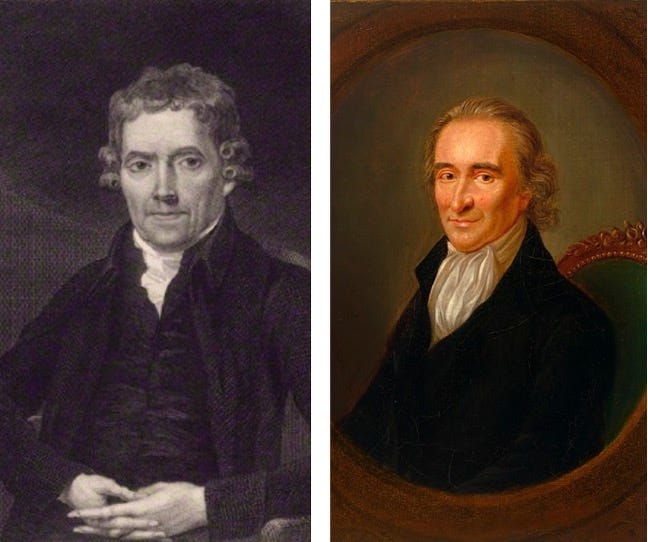
Mary and Godwin ran in the same radical literary circle in London; therefore it was inevitable they would one day end up in the same room. But it was not until nearly a year after A Vindication of the Rights of Men came out that they sat across from one another at a dinner in honor of Thomas Paine hosted by Joseph Johnson. Johnson (pictured to the left in the image below) was known for bringing radicals together at his weekly dinners, and Thomas Paine (pictured to the right) was a hero in London. English radicals held him in high regard for his influence on the American Colonies during their War of Independence. Back on European soil, Paine was taking delight in stirring sentiment in favor of the French.
Godwin arrived that evening, eager to hear what Paine had to say. Instead, Mary dominated Paine’s time and attention, firing questions at him, exchanging views with the radical in a way that stole his attention. Her audacity irritated Godwin, and he made no secret of his disdain. Godwin had already brushed aside A Vindication of the Rights of Men when it hit the stands, saying it was filled with poor grammar and had been carelessly written. He liked Mary even less in person and soon was sparring with her. “The interview was not fortunate,” Godwin would later write in a memoir about Mary that he would pen years later. “Mary and myself parted, mutually displeased with each other.”[1]
In the year that followed, Mary and Godwin ran into each other several more times, but neither warmed up to the other. Six weeks after their infelicitous meeting, Mary published A Vindication of the Rights of Woman, which would earn her international praise as a voice for women’s equality. Unbeknownst to her, or perhaps she was well aware, Godwin was working on his own polemical masterpiece.
Twelve months later, however, Mary left for France to write about the French Revolution and did not return for nearly four years. When she did, it was a matter of time before they would run into each other again. Their circle of friends remained small, and like attracts like. During her absence, Godwin had published his now famous text, An Enquiry Concerning Political Justice. When they met again in 1796, both had changed, creating space for them to see each other anew.
So who was Mary Wollstonecraft, and what would prompt two radical philosophers to put aside their antipathy toward marriage and tie the knot?
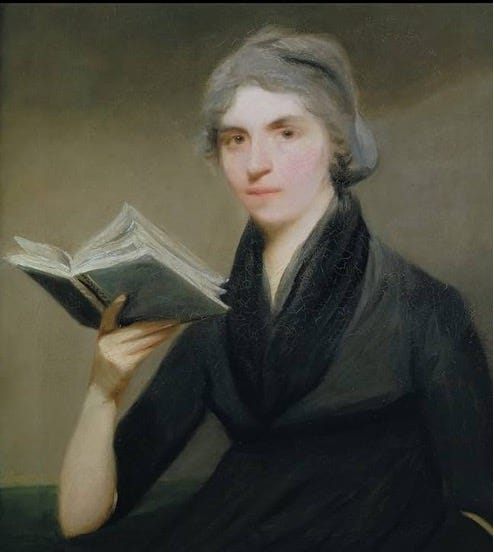
Early in life, Mary Wollstonecraft declared she would live life singly, and she had good reason. A precocious child, she grew up in a genteel, middle-class family. But her father, Edward, who had inherited a fortune from his father, a wealthy silk weaver from Spitalfields, was an abusive, reckless man. By the time Mary reached her teens, he had squandered the family money. He had even spent Mary and her sisters’ dowries, which Mary’s mother, Elizabeth, had brought to the marriage. None of the girls would now likely make good matches. (Image above: Mary Wollstonecraft, painted by an art student while Wollstonecraft was living in Ireland working as a governess, c. 1787).
Not that Mary wanted to marry. Being the recipient of physical abuse and witnessing the way her father degraded her mother sexually and took control of her wealth, Mary feared that, below the surface, all men had the potential to be a tyrant like her father. Coverture was the law of the land; men could do what they wished. The only way for Mary to protect herself, she decided, was to avoid marriage altogether.
Mary, however, did not emerge from her childhood unscathed. She would face a lifetime of episodic depression. Today she might be diagnosed with bipolar disorder, but in the 18th century, mood swings were attributed to melancholy. To shield herself from her family’s dysfunction, Mary immersed herself in books.
Other than limited instruction by her mother, Mary enjoyed no more than approximately three years of formal instruction. The standard curriculum for girls was trifling at best, anyway. Hungry to know more, Mary found learning where she could. Among her first mentors were Jane Arden and Jane’s father, John Arden, whom Mary met when the Wollstonecrafts moved to Beverly in East Yorkshire in 1771. Jane became Mary’s first best friend. (Read more about their friendship in my guest post in the Literary Ladies’ Tearoom on Substack.) John Arden, an academic and traveling lecturer, took it upon himself to tutor Mary along with his own children. Time with the Ardens allowed Mary to thrive intellectually and observe how a functioning family lived compared to her chaotic home life.
When Mary was fifteen Edward Wollstonecraft moved his family to Hoxton, tearing Mary from the Ardens, sending her into a deep depression. In Hoxton, Mary’s new neighbors, the elderly Reverend and Mrs. Clare, took an interest in her. Reverend Clare opened his library to Mary while Mrs. Clare nursed her wounded spirit. Several years later Mary would write to Jane Arden saying, “They took some pains to cultivate my understanding (which had been too much neglected) they not only recommended proper books to me, but made me read to them; — I should have lived very happily with them if it had not been for my domestic troubles, and some other painful circumstances, that I wish to bury in oblivion.”[2]
Mary would stay with the Clares for weeks at a time, and it was through them that she met Fanny Blood, a girl two years older than Mary, who in the same letter to Jane Mary described as someone “whom I love better than all the world beside, a friend to whom I am bound by every tie of gratitude and inclination.”[3] It became Mary’s dream for her and Fanny to live together and, by their own agency, make a living.
It was not to be. When the girls first met, Fanny was in the early stages of consumption. Mary would, however, spend the next decade trying to position herself and Fanny for a life together, despite Fanny being engaged to a wine merchant tending his family’s business in Lisbon. He was an absent fiancé, making it easy for Mary to assume he was not a serious suitor. She took a position as a companion to a wealthy woman in Bath to save up money for her and Fanny, then later opened her own school in Newington Green, where she and Fanny and Mary’s sisters taught while Mary simultaneously served as headmistress. But in 1785, Fanny’s consumption had advanced. Her fiancé finally sent for her, and she moved to Lisbon, where she died shortly after giving birth to a son, who also died.
Mary had sailed to Lisbon to be with Fanny during the birth and was now bereft. In her grief, she wrote her first book. Thoughts on the Education of Daughters launched Mary’s career as a writer, but during her stay in Lisbon, Mary’s school, which she had left in the hands of her sisters, suffered from mismanagement, and subsequently closed.
Mary spent the next year as a governess to the three eldest daughters of Lord and Lady Kingsborough, Ireland's wealthiest Protestant family. The arrangement did not suit Mary, nor did it the Kingsboroughs, who fired her for her progressive views on girls’ education. Three days later, Mary moved to London to become a writer.
In a future Woldwinite article, we’ll discuss Mary’s most important achievement, A Vindication of the Rights of Woman, which would become one of history’s most important feminist essays of all time. We’ll also dip into Mary’s time in Revolutionary France and her eventual return to London, when she would once again encounter William Godwin.
[1] Godwin, William, Memoirs of the Author of A Vindication of the Rights of Woman, edited by Pamela Clemit & Gina Luria Walker (Broadview Press Ltd., 2001), 80.
[2] Todd, Janet, ed., The Collected Letters of Mary Wollstonecraft. (Columbia University Press, 2003), 24.
[3] Ibid, 24-25.
N.J. Mastro is the author of Solitary Walker: A Novel of Mary Wollstonecraft, which is a fictional account of Mary’s incredible rise as a writer, Mary and Godwin’s unlikely courtship, and their revolutionary approach to married life.
Do you think that the Kingsboroughs merely wanted a published author for a governess for the status? Had they even read her work?